The Difference Between Being Tempted and Being Tested
You’ve probably heard someone sort a hard season into one of two bins. Either it’s a test God is running, or it’s a temptation the enemy is running. Two separate words, two separate sources, easy to keep straight.
Then you sit down and actually read the chapter both ideas come from, and the bins start to blur. James reaches for the same word both times. Not a similar word. The same one.
That’s not a contradiction he missed. It’s the whole reason this passage exists. He knows the word does double duty, and instead of swapping it out for something safer, he spends most of a chapter making sure you don’t draw the wrong conclusion from it.
“Let no man say when he is tempted, I am tempted of God; for God cannot be tempted with evil, and he himself tempteth no man: but each man is tempted, when he is drawn away by his own lust, and enticed.” — James 1:13-14, ASV
Key Takeaways
James 1 uses one Greek word, peirasmos, for both “tempted” and “trials.” The word itself never tells you which one you’re in.
What separates them is the source. A test proves what’s already true in you, aimed at endurance. A temptation is drawn from your own lust, aimed at death.
God is not the one pulling you toward sin (James 1:13). He’s the one who stays exactly the same while everything else around you moves (James 1:17).
The real question isn’t “is this a test or a temptation.” It’s “where is this coming from, and where is it trying to take me.”
If you genuinely can’t tell, James doesn’t leave you stuck there. Verse 5 tells you exactly what to do next.
Why Does the Bible Use the Same Word for Both?
Open an interlinear on James chapter 1 and the seam shows up fast. Verse 2 says, “count it all joy when ye fall into manifold temptations.” Verse 12 says, “blessed is the man that endureth temptation.” Verse 13 says, “let no man say when he is tempted, I am tempted of God.”

“Temptations” in verse 2, “temptation” in verse 12, and “tempted” in verse 13 are all the same Greek root: peirasmos as a noun, peirazo as the verb. Your English Bible has to pick a different word in different spots so the sentence does not sound insane, but the original text never switches.
So the word by itself carries no verdict. It does not tell you whether what is leaning on you right now is meant to strengthen you or destroy you. James is not going to hand you a different vocabulary word depending on which one you are in. He gives you something better instead: a way to trace the thing back to where it actually started.
Before this word ever meant “tempt toward sin,” it was ordinary testing language. Metal put through fire to prove it was real, not counterfeit. A legal case put through examination to prove it would hold up. The word starts out neutral. It only picks up its darker sense from what is doing the testing, and what that thing is reaching for.
What a Test Actually Does to You
James opens the chapter naming this kind directly. “Count it all joy when ye fall into manifold temptations, knowing that the proving of your faith worketh patience” (James 1:2-3, ASV). The word he uses for “proving” there is about authenticating something, the same idea as testing metal. The pressure is not there to break you. It is there to show what was already true, the way heat does not create gold, it reveals it.
That is the shape of a real test. It comes from outside, it is aimed at something being proven, and the target is endurance, patience, a finished and complete faith (verse 4). You come out the other side more yourself, not less.
This is the same shape sitting under Abraham on the mountain in Genesis 22, the same theological point James makes here. A different Hebrew word there, nissah, but the same idea. God was not manufacturing a desire in Abraham to see if he would act on it. He was proving what was already true, so it could be seen by Abraham himself and by everyone who reads it after him. A test does not put something into you that was not there. It brings out what already was.
What a Temptation Actually Aims At
Verse 14 names the other kind with the same bluntness James used for the first: “each man is tempted, when he is drawn away by his own lust, and enticed.” The Greek word behind “enticed” is a fishing term. Bait, moving toward a hook.
Notice where James puts the source. Not “the devil tempted him,” though Scripture is clear the enemy is real and active. James goes one layer deeper, to the appetite inside a person that the bait is aimed at. Verse 15 finishes the sentence: “then the lust, when it hath conceived, beareth sin; and the sin, when it is full grown, bringeth forth death.” A temptation is not proving something that is already good in you. It is pulling on something that, left alone, grows into something that costs you.
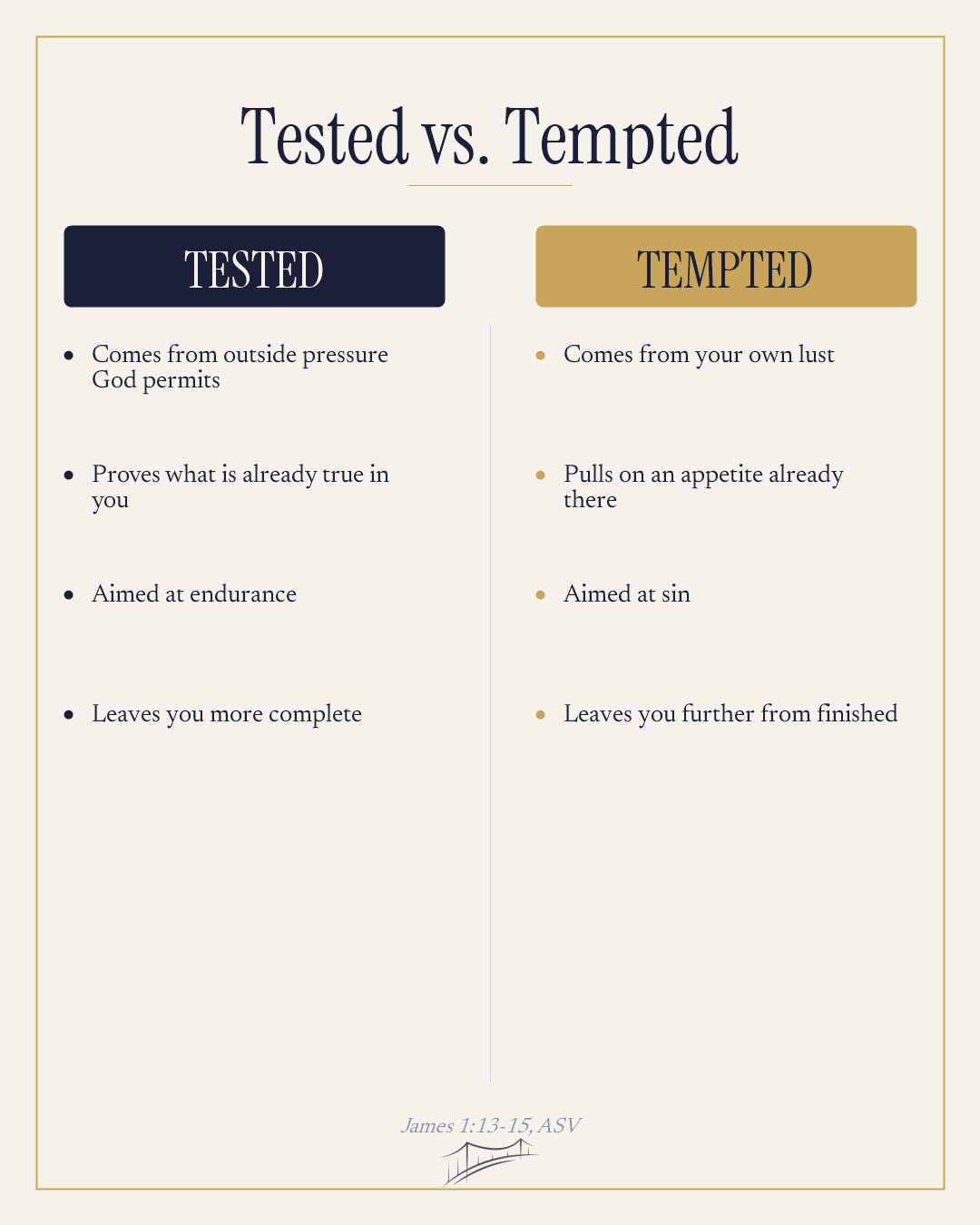
That is the opposite direction of a test. A test comes from outside pressure God permits, aimed at revealing endurance that is already forming. A temptation comes from an appetite already inside you, aimed at a hook you cannot see until you are already caught on it.
How to Tell Which One You Are In
Same word. Same feeling, most days, from the inside. So how do you actually know.
You do not start by naming the pressure. You start by asking where it is pointed. A test is pointed at your endurance, and it ends in you being more complete, “lacking in nothing” (verse 4). A temptation is pointed at your appetite, and it ends in something being taken from you, not built into you.
You can ask it a second way too, the way the difference between guilt and conviction works the same territory from another angle. Guilt and conviction can feel nearly identical in the moment. What tells them apart is where each one leaves you. One leaves you closer to God. The other leaves you circling yourself. Testing and temptation split the same way. One leaves you more finished. The other leaves you further from finished than when it started.
This is also close cousin to the difference between judging and discernment. Both pairs get treated like they are interchangeable because the surface feeling matches. In both cases, Scripture does not ask you to trust the feeling. It asks you to trace the thing to its actual root.
Paul draws the same line in 1 Corinthians 10:13: “God is faithful, who will not suffer you to be tempted above that ye are able; but will with the temptation make also the way of escape.” Same word family again, peirasthenai. Paul is not inventing a private use of it. The whole New Testament expects you to sort this word by its source and its aim, every single time it shows up.
The Line You Can Actually Stand On

Here is the verse that resolves the tension, and it is not verse 13. It is verse 17: “Every good gift and every perfect gift is from above, coming down from the Father of lights, with whom can be no variation, neither shadow that is cast by turning.”
That is the anchor. God does not flip between generous and cruel depending on your circumstances. If what is pressing on you is dragging you toward something ugly, trace it back far enough and it was never coming from Him. It was already living in you as an appetite, or it is an outside pull aimed at that appetite. Either way, His character has not moved an inch. He is the steady point you check everything else against, the same way Ephesians 1:4 roots your security in something that was settled before you ever had a reason to doubt it.
What to Do When You Genuinely Cannot Tell
Sometimes you are too close to it to sort test from temptation in real time. James does not leave that gap open. The very next verse after the section on trials says exactly what to do: “if any of you lacketh wisdom, let him ask of God, who giveth to all liberally and upbraideth not; and it shall be given him” (James 1:5).
That is not an accident of placement. James moves from here is a pressure that could be either straight into here is what to do when you cannot tell which one it is, and the answer is not figure it out yourself faster. It is ask. This is exactly the difference between being smart and being wise: you can know the theology of testing and temptation cold and still not know what to do with it in the actual moment. That gap is what wisdom closes. It is the kind of discernment Walking in Wisdom spends eight weeks building, the practical ability to know what to do with what you already know when the moment actually shows up.
If you want to sit with a full week of that kind of practice rather than one blog post worth, the Walking in Wisdom Personal Kit walks the same territory this post opened, one chapter of Proverbs at a time, with room to actually work it out on the page instead of just reading about it.

Get the free Week 1 sampler from Walking in Wisdom, the same study, one real week, before you decide if the whole eight makes sense for you.
Frequently Asked Questions
What is the difference between temptation and a trial in the Bible
Both often translate the same Greek word, peirasmos. A trial or test comes from outside pressure God permits, aimed at proving and strengthening what is already true in you. A temptation is drawn from your own lust, aimed at pulling you toward sin. The word does not tell you which one you are in, the source and the direction do.
Is James 1:13 saying God never tests anyone
No. James 1:2-4 is explicitly about God-permitted trials that produce endurance. Verse 13 is narrower: it is ruling out the idea that God is the one drawing a person toward sin. Testing and tempting toward sin are both real in Scripture, they are just never the same thing, even when English uses overlapping words for both.
What does the Greek word peirasmos actually mean
At its root, it means a putting to the test, or a trial. It was originally neutral testing language, similar to proving metal was genuine. It is the context, not the word itself, that determines whether a given peirasmos is a trial meant to strengthen or a temptation aimed at sin.
How do I know if a hard season is meant to strengthen me or if I am being pulled toward sin
Ask where it is pointed, not just how it feels. A trial is aimed at endurance and leaves you more complete. A temptation is aimed at an appetite and leaves you further from where you wanted to be. If you are genuinely unsure, James 1:5 says to ask God for wisdom directly rather than trying to sort it out alone.
What does James 1:17 mean by no variableness, neither shadow of turning
It means God’s character does not shift with your circumstances. He is not sometimes generous and sometimes cruel depending on what season you are in. Every good gift traces back to Him consistently, which is also how you can trust that He was never the source of whatever is pulling you toward sin.
Where does wisdom fit into telling testing and temptation apart
James places the invitation to ask for wisdom, verse 5, immediately after the section on trials, which suggests discernment in the moment matters more than a perfect theological definition worked out in advance. Practical wisdom, the kind Proverbs teaches and Walking in Wisdom studies week by week, is what lets you actually apply this distinction in real time instead of only after the fact.
Father,
You do not shift. Whatever is pressing on me right now, You have not changed shape behind it. If it is proving something true in me, let it finish the work instead of me cutting it short out of fear. If it is pulling me somewhere You never sent me, show me the hook underneath the bait before I take it. I do not want to keep sorting my life into a test or a temptation from the outside anymore. I want to know the source. Every good gift comes from You, and You do not take turns being good and then not. Keep me close enough to tell the difference next time.
In Jesus’ name, Amen.
Right now, in whatever you are walking through, does it feel like it is proving something in you, or pulling you somewhere you do not want to go. Tell me below. I would love to sit with it alongside you.