

The Difference Between Being Smart and Being Wise
“The fear of Jehovah is the beginning of wisdom; And the knowledge of the Holy One is understanding.” — Proverbs 9:10, ASV
Before you read (the short version):
Smart is what you know. Wise is what you do with it when the moment actually shows up.
In Proverbs, wisdom isn’t IQ. The Hebrew word is chokmah — skill in living.
You can be the smartest person in the room and still make a foolish choice. Wisdom is knowledge bent toward God and put to use.
It starts with the fear of the Lord, and it’s built in ordinary moments, not big ones.
You already know a lot. Most of us do. We’ve read the books and saved the posts. And still, there are mornings you stand in the middle of a decision you can’t think your way out of.
That gap has a name. It’s the difference between being smart and being wise. Proverbs spends thirty-one chapters on it, because God knew we’d need the difference spelled out.
Let me walk you through what Proverbs actually means, because it isn’t what most of us were taught.
If Proverbs is where you want to grow, I made the first week of my Walking in Wisdom study free — it’s linked below.
What we usually mean by “smart”
When we call someone smart, we mean they know things. They’re quick, and they can explain what they’ve read. Smart is about input. It’s what’s gone into your head.
And smart is good. God isn’t against knowledge. But smart has a ceiling, and you’ve probably hit it. You can know exactly what the Bible says about worry and still lie awake worrying. You can know the right thing and not do it. Knowledge alone doesn’t move you.
What Proverbs means by “wise”
Here’s where it gets interesting. The Hebrew word Proverbs uses for wisdom is chokmah. In the Old Testament, that same word describes the skill of a craftsman — the person who could actually build the tabernacle, not just talk about it (Exodus 31:3).
So wisdom in Proverbs isn’t a high test score. It’s skill in living. It’s knowing how to handle your actual life — your money, your mouth, your relationships, your Tuesday. Wisdom takes what you know and turns it into how you live.
“The fear of Jehovah is the beginning of knowledge; But the foolish despise wisdom and instruction.” — Proverbs 1:7, ASV
Proverbs has a word for the person who’s smart but not wise. It calls him a fool. And in Proverbs, a fool isn’t stupid. A fool is someone who knows better and lives like he doesn’t.
That’s why smart people still wreck things. The information was never the problem. The foolishness is a heart that won’t submit what it knows to God. You can hold the right answer and still hand the wheel to your fear or your pride.
Where wisdom actually begins
Proverbs is blunt about the starting line. The fear of the Lord is the beginning of wisdom (Proverbs 9:10). Not a degree. The fear of the Lord.
And that word “fear” trips people up, so let me be clear. It doesn’t mean being scared of God, bracing to get it wrong. It means reverence. It means He gets the final word. Wisdom begins the moment you stop being your own highest authority and let God be God.
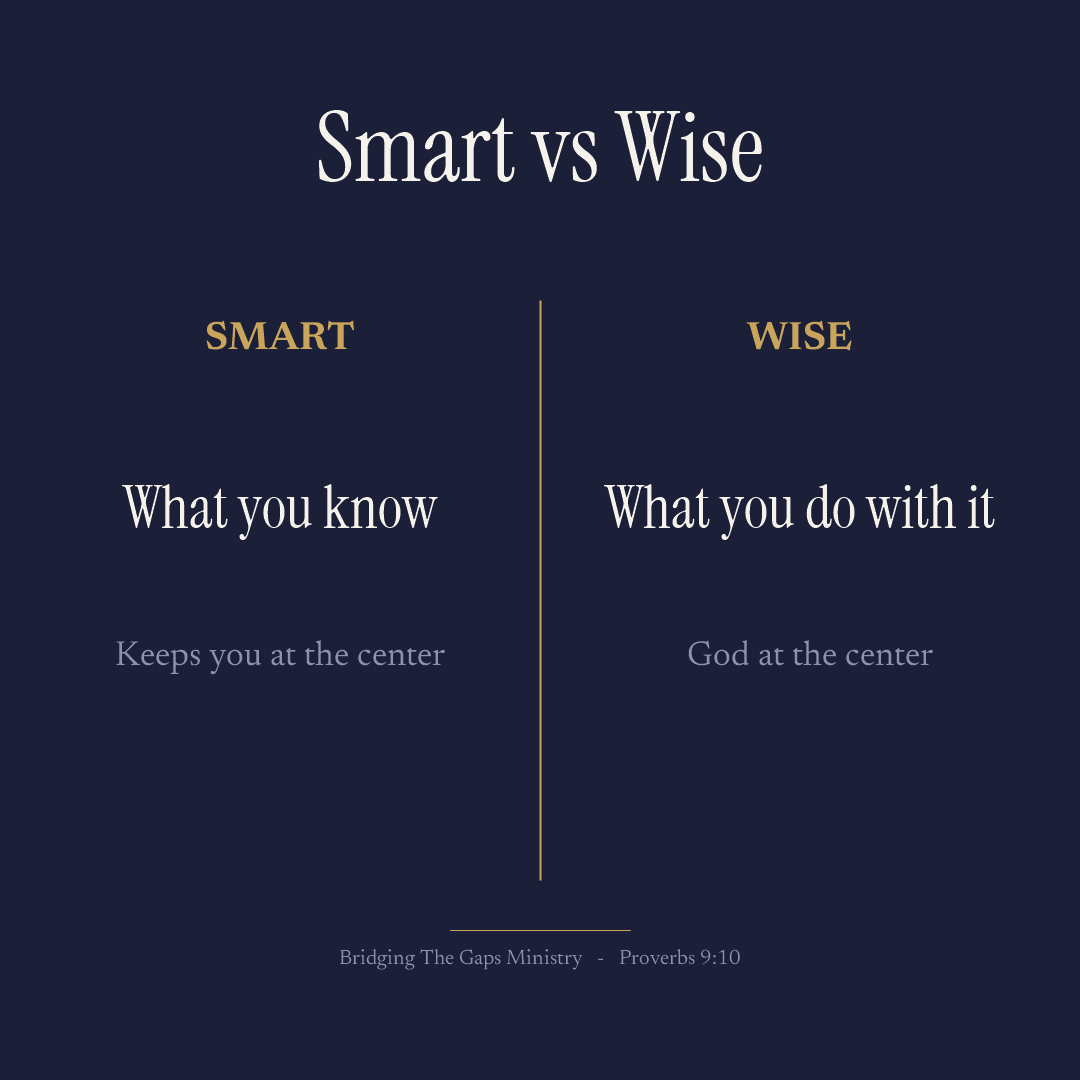
That’s the hinge. Smart collects information and keeps itself at the center. Wisdom takes the same information and bends it toward God. Same facts, different King.
How wisdom actually gets built
“Trust in Jehovah with all thy heart, And lean not upon thine own understanding: In all thy ways acknowledge him, And he will direct thy paths.” — Proverbs 3:5-6, ASV
What to do with this, this week
Don’t try to become wise by Friday. Pick one decision you’re already facing and bring it to God before you bring it to your own head. Ask Him. James says if any of us lacks wisdom, we can ask, and God gives it freely, without holding our past against us (James 1:5).
That’s the whole shift. Smart asks, “What do I know?” Wisdom asks, “God, what do You say?” — and then does it.
Want to go deeper in Proverbs?
The first week of my Walking in Wisdom study is free — the study plus printable verse cards, sent straight to you. It’s built for exactly this: bringing Proverbs into the decisions you’re already making. Get the free Week 1 sampler.
And if you want the full eight weeks, Walking in Wisdom is on Amazon in paperback and Kindle, with companion study kits for personal, group, and church use on the shop.
Father, You’re the beginning of wisdom, and I’ve been trying to think my way through things I was meant to bring to You. Teach me to trust You with my whole heart instead of leaning on what I already know. Make me steady, not just smart. Amen.
Where do you most need wisdom right now — not more facts, just clarity? Tell me in the comments.
Frequently asked
Is being wise the same as being intelligent?
No. Intelligence is what you know. Wisdom is skill in living — knowing what to do with what you know, God’s way. You can have one without the other.
Does “the fear of the Lord” mean being scared of God?
No. It means reverence — letting God have the final word. It’s the opposite of keeping yourself at the center.
How do I actually get wisdom?
Ask God for it. James 1:5 says He gives it freely to anyone who asks, without shaming you for needing it. Then practice trusting Him in the small, everyday decisions.
What’s the difference between knowledge and wisdom in the Bible?
Knowledge is information. Wisdom is applied, God-centered living. Proverbs 1:7 puts the fear of the Lord at the start of both.
