

What It Actually Means to Be Rooted in Christ
"that Christ may dwell in your hearts through faith; to the end that ye, being rooted and grounded in love, may be strong to apprehend with all the saints what is the breadth and length and height and depth, and to know the love of Christ which passeth knowledge, that ye may be filled unto all the fulness of God." Ephesians 3:17-19, ASV
Key takeaways
Being rooted in Christ is Paul's picture of a faith that holds up when life gets hot and dry. It isn't a feeling you have to keep up on your own.
In Ephesians 3:17 Paul puts two words side by side. Rooted is a plant's word, and grounded is a builder's word for laying a foundation.
The roots go down into love, Christ's love for you, and Paul prays you'd have the strength to take in how big it is.
Roots grow out of sight and over time. God does the strengthening, and your part looks like staying planted by the water.
"Rooted in Christ" is one of those phrases we hear so often that it can stop meaning much. It's on mugs and wall art, and we pray it over each other. But if someone asked you what it looks like on a Wednesday afternoon when everything feels thin, it might be hard to put into words.
That's worth slowing down for. Paul didn't pick this word because it sounded nice. Roots do something very specific, and he wanted the church in Ephesus to know that the same thing could be true of them.
So let's look at what Scripture actually says about being rooted, where the picture comes from, and what it looks like to grow roots when you're tired.
Where does "rooted in Christ" come from in the Bible?
Paul uses the word in two letters. The first time is in the middle of a prayer. In Ephesians 3 he says he bows his knees "unto the Father," and he asks that the believers would be "strengthened with power through his Spirit in the inward man" (Ephesians 3:16). Then comes our verse: "that Christ may dwell in your hearts through faith; to the end that ye, being rooted and grounded in love" (Ephesians 3:17).
The second time is in Colossians:
"As therefore ye received Christ Jesus the Lord, so walk in him, rooted and builded up in him, and established in your faith, even as ye were taught, abounding in thanksgiving." Colossians 2:6-7, ASV
Look at the order there. First you receive Christ Jesus the Lord. Then you walk in Him, rooted and built up. Being rooted is what grows after you belong to Him, and it was never the price of getting in. If that order has ever felt mixed up for you, Saved But Still Growing walks through the difference between salvation and sanctification.
What does "rooted" mean in the Greek?
The word Paul uses for rooted is rhizoó (Strong's G4492). It comes from rhiza, the everyday word for a root. It means to take root, and it's also used to mean becoming stable.
The word right beside it, grounded, is themelioó (Strong's G2311). That one comes from the word for a foundation. It's what a builder does before a single wall goes up.
So in one short phrase, Paul gives you a tree that has taken root and a building set on its foundation. Both pictures are about what's underneath. You can't see a root or a foundation when you look at a tree or a house. You find out how deep they go when the weather turns.
There's one more word in that verse worth noticing. Dwell is katoikeó (Strong's G2730), and it means to live somewhere as your settled home. Paul isn't praying that Christ would stop by your heart now and then. He's praying that Christ would make His home there.
What happens to faith that has no root?
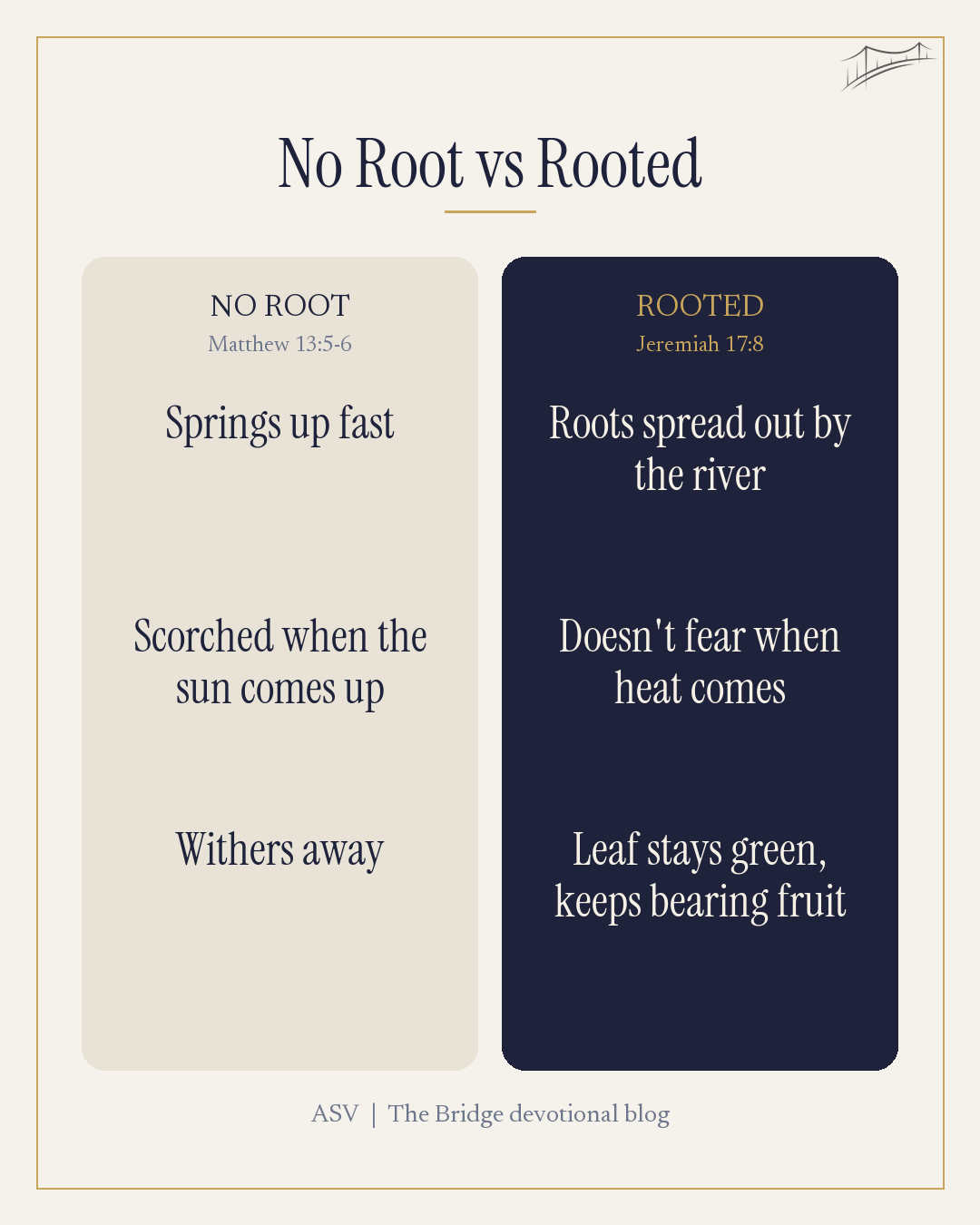
Jesus told a story that shows this better than anything. In the parable of the sower, some seed fell "upon the rocky places, where they had not much earth: and straightway they sprang up, because they had no deepness of earth: and when the sun was risen, they were scorched; and because they had no root, they withered away" (Matthew 13:5-6).
Then He explained it. That seed is the one "that heareth the word, and straightway with joy receiveth it; yet hath he not root in himself, but endureth for a while; and when tribulation or persecution ariseth because of the word, straightway he stumbleth" (Matthew 13:20-21).
That plant came up fast. It looked alive, and it even had joy. What it didn't have was anything underneath, so the first hot day was too much for it.
If that sounds familiar, you're not the only one. Plenty of us have had a stretch where faith felt real and warm, and then the heat came and we felt scorched almost right away. It isn't the end of your story. Scripture shows us what rooted faith looks like, and it shows us who does the growing.
What does a rooted life actually look like?
Jeremiah gives one of the clearest pictures in the whole Bible:
"Blessed is the man that trusteth in Jehovah, and whose trust Jehovah is. For he shall be as a tree planted by the waters, that spreadeth out its roots by the river, and shall not fear when heat cometh, but its leaf shall be green; and shall not be careful in the year of drought, neither shall cease from yielding fruit." Jeremiah 17:7-8, ASV
Read that slowly. The heat still comes, and so does the year of drought. What's different is the tree. It "shall not fear when heat cometh," its leaf stays green, and it keeps bearing fruit.
A rooted woman still has hard weeks. She still gets tired, and she still cries in the car sometimes. What changes is where she's drawing from. Her roots have found the river, so a dry stretch doesn't dry her out.
The heat still comes. A rooted tree has already found the river.
Rooted faith is also quiet. Nobody walks past a tree and admires its roots. The growth that matters most is usually the growth nobody else sees, like the prayer you whisper on the drive to work or the verse you read twice because it stuck. That kind of growth counts, even on days you can't feel it. We wrote more about that in Why Reading the Bible Changes You.
What are we supposed to be rooted in?
This is the part that's easy to rush past, and it's the best part. Paul tells us exactly what the roots go down into: "rooted and grounded in love."
Then he tells us what he's praying that love would do. He wants believers to "be strong to apprehend with all the saints what is the breadth and length and height and depth, and to know the love of Christ which passeth knowledge" (Ephesians 3:18-19).
Think about that for a minute. Paul prays for strength just so we can take in how much Christ loves us. It's bigger than our minds can hold, and he still prays that we'd know it.
That's why being rooted in Christ starts with His love, and His love was there before you did a single thing right. If you've been living like you have to earn your place with God, God Doesn't Need You to Have It Together First is a good next read.
Who does the growing?
Here's something freeing. Look at who's doing the work in Paul's prayer. He asks the Father to grant it, and the strength comes "through his Spirit in the inward man" (Ephesians 3:16). God is the one doing the rooting.
Your part looks a lot like the tree in Jeremiah. It stays planted by the water, the tree "that spreadeth out its roots by the river."
In everyday life, staying by the water can be as simple as opening your Bible on a day you don't feel anything, or praying honestly when you're not sure what to say. If prayer has felt hard lately, What to Do When You Don't Feel Like Praying might help. Slow and steady is how roots go down.
And when it's taking longer than you'd like, remember how Paul ends this prayer: "Now unto him that is able to do exceeding abundantly above all that we ask or think, according to the power that worketh in us" (Ephesians 3:20). He can grow what you can't grow on your own.
How can you grow deeper roots this week?
Read Ephesians 3:14-21 as a prayer for you
Paul prayed these words for real people. Read them slowly, then pray them back to God in your own words.
Carry one verse with you
Write Ephesians 3:17 on a card or save it in your phone. Come back to it when the day gets hot.
Notice what you've been drawing from
When you feel scorched, ask yourself what you've been leaning on. Then bring that honestly to the Lord. If you've been feeling far from Him and can't tell why, Why You Feel Far From God When Nothing Is Wrong is for you.
Stay close to other believers
Paul prays that we'd take in Christ's love "with all the saints." That's something we get to do together, so let your church or small group in on what you're learning.
Go deeper in Ephesians

Week 3 of our study, IN HIM: A 6-Week Ephesians Bible Study for Women, is called Rooted in God's Love. It spends the whole week in Ephesians 3, with the full chapter printed in the ASV, teaching, discussion questions and four days of steps to apply it. The study was written "To every woman who feels tired, uncertain, unseen, or stretched thin."
Week 1 is free. Enter your email and we'll send it to you. Get the free Week 1 sampler
If you'd like the whole study, IN HIM is on Amazon in paperback and Kindle. You can read more about it on the IN HIM Women's Edition page, and you'll find all of our studies on the Bible Studies page.
Father, thank You that my roots don't depend on how strong I feel today. Strengthen me through Your Spirit in the places nobody else sees. Let Christ make His home in my heart, and help me take in how wide and deep His love really is. Keep me planted by the water when the heat comes. In Jesus' name, Amen.
Where do you feel the heat most right now, and what's been helping your roots go down? Tell us in the comments.
Frequently asked questions
What does it mean to be rooted in Christ?
It means your faith is anchored in Christ and His love the way a tree is anchored by its roots. Paul uses the word in Ephesians 3:17 and Colossians 2:7 for believers who stay steady because of what's underneath them.
What's the difference between rooted and grounded in Ephesians 3:17?
Rooted (rhizoó) is a plant word about taking root. Grounded (themelioó) is a building word about laying a foundation. Paul puts them together so you get both pictures of a life that stands firm.
What Bible verses talk about being rooted?
Ephesians 3:17 and Colossians 2:7 use the word directly. Jeremiah 17:8 and Psalm 1:3 describe a tree planted by the water, and Jesus talks about seed with "no root" in Matthew 13:6.
How long does it take to become rooted in your faith?
Scripture doesn't give a timeline. Roots grow out of sight, and Paul asks the One who "is able to do exceeding abundantly above all that we ask or think" to do the strengthening (Ephesians 3:20).
Can you be saved and still feel like your roots are shallow?
Yes. In Colossians 2:6-7, being rooted and built up comes after receiving Christ. Salvation is where it starts, and growing deeper is part of walking with Him after that.
