

"Bless Jehovah, O my soul, And forget not all his benefits:" Psalm 103:2, ASV
Key takeaways
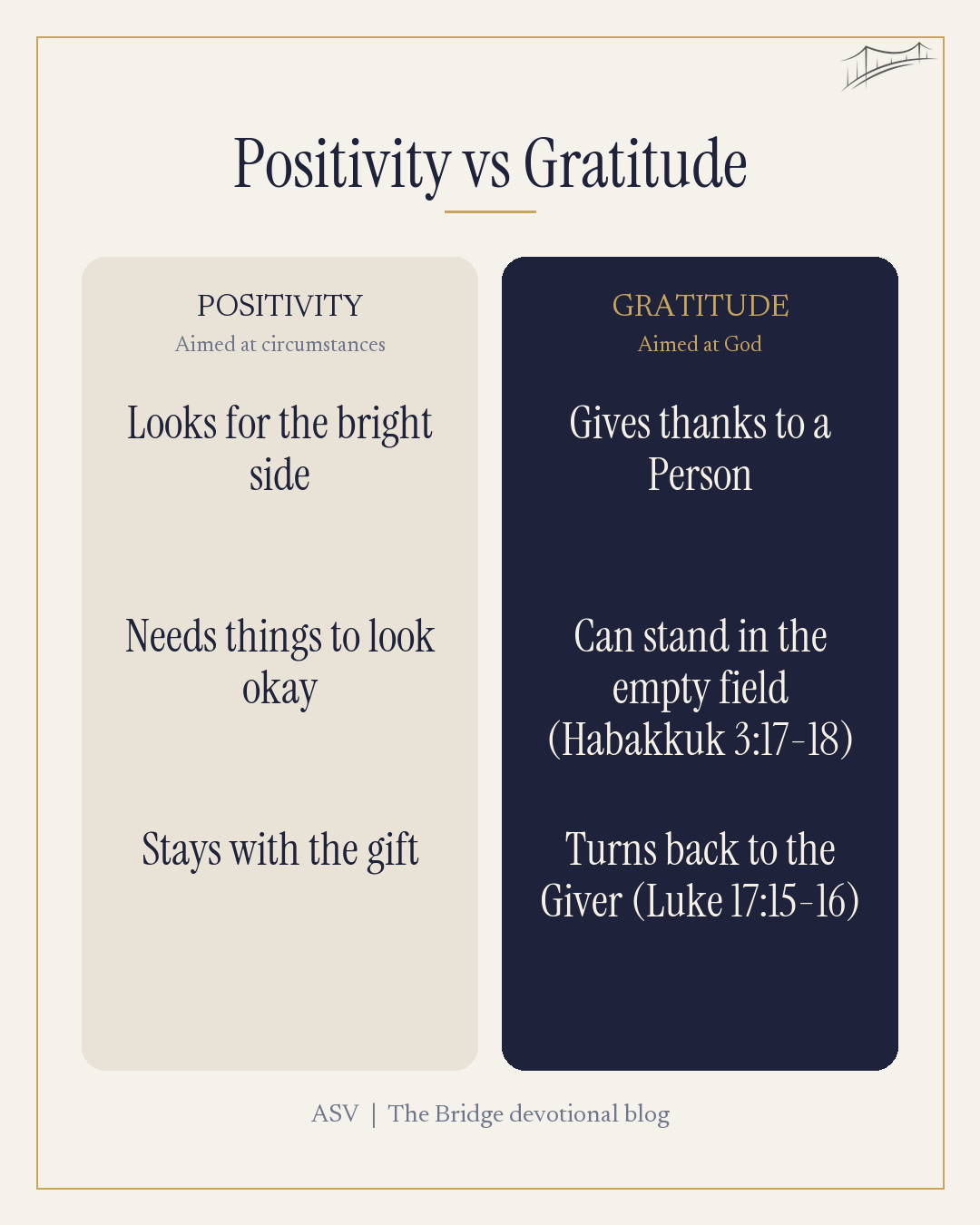
Positivity is a way of looking at your circumstances. Gratitude in the Bible is thanks given to God for who He is and what He's done.
Positivity needs things to look okay. Biblical gratitude can stand in a hard place, the way Habakkuk rejoiced in God while every field came up empty.
Being thankful doesn't mean pretending. Psalm 13 moves from honest questions to "I will sing unto Jehovah."
Gratitude grows by remembering, which is why Psalm 103 says "forget not all his benefits."
There's a lot of pressure to stay positive. Look on the bright side, keep your chin up, don't be negative. A lot of us have quietly taken that on as if it's the same thing as being thankful.
It isn't, and the difference matters most on the days you can't find a bright side at all.
Positivity tries to see your circumstances in the best light. Gratitude looks past the circumstances to God, who is still good and still worth thanking. Here's what Scripture shows about the difference, and how real gratitude grows.
What's the difference between gratitude and positivity?
Positivity is mostly about how you choose to see what's in front of you. You look for the good, and you try not to dwell on what's wrong. There's nothing sinful about that. It's aimed at your circumstances, though, so it only works as long as you can find something good in them.
Gratitude in Scripture points somewhere else. It's aimed at a Person. When the Psalms talk about giving thanks, they name who the thanks is for. Psalm 92:1 says, "It is a good thing to give thanks unto Jehovah." The thanks has an address on it.
You can feel positive about nothing in particular. Gratitude always has someone on the other end of it.
What does the Bible's word for thanksgiving mean?
One of the main Old Testament words is todah (Strong's H8426). It's used for thanksgiving, for a thank offering, and even for confession, saying out loud what's true. It comes from yadah (Strong's H3034), to give thanks.

Psalm 50 talks about it as something you bring: "Offer unto God the sacrifice of thanksgiving" (Psalm 50:14). A few verses later God says, "Whoso offereth the sacrifice of thanksgiving glorifieth me" (Psalm 50:23).
A sacrifice costs something. So thanksgiving isn't always the easy, overflowing kind. Sometimes it's something you bring to God on purpose, on a day you'd rather complain.
In the New Testament the word is eucharisteó (Strong's G2168), to be grateful and to give thanks. It's the word in 1 Thessalonians 5:18: "in everything give thanks: for this is the will of God in Christ Jesus to you-ward."
Read that slowly. It says in everything. You don't have to be glad a hard thing happened in order to give thanks while you're in the middle of it.
Can you be grateful when nothing is going right?
Habakkuk shows that you can. Near the end of his book, he lists everything that's failing:
"For though the fig-tree shall not flourish, Neither shall fruit be in the vines; The labor of the olive shall fail, And the fields shall yield no food; The flock shall be cut off from the fold, And there shall be no herd in the stalls: Yet I will rejoice in Jehovah, I will joy in the God of my salvation." Habakkuk 3:17-18, ASV
There's nothing positive in that list. Every crop and every animal he was counting on has come up empty. He doesn't pretend otherwise, and he doesn't talk himself into a bright side.
He says, "Yet I will rejoice in Jehovah." His joy is resting on "the God of my salvation," and God hadn't changed just because the harvest did.
That's the difference in one passage. Positivity would need the fields to turn around. Gratitude and joy can stand right there in the empty field. We spent a whole Faith for the Week episode in these verses, and you can listen to Yet I Will Rejoice here.
Does being grateful mean you can't be honest about what hurts?
The Psalms answer that one for us. So many of them are honest prayers that end in thanks without skipping the hard part.
Psalm 13 opens with David asking God "how long" again and again. By the end he says:
"But I have trusted in thy lovingkindness; My heart shall rejoice in thy salvation. I will sing unto Jehovah, Because he hath dealt bountifully with me." Psalm 13:5-6, ASV
David didn't have to act fine to get to thankfulness. He told God the truth first.
Philippians 4:6 puts the same two things side by side: "in everything by prayer and supplication with thanksgiving let your requests be made known unto God." You bring your real requests, and you bring thanks along with them. Paul never asks you to trade one for the other.
Positivity can make hard feelings seem like a failure. Gratitude in the Bible has room for tears and thanks in the same prayer. If you've been in a stretch where God feels distant, Why You Feel Far From God When Nothing Is Wrong might be a good next read.
Why does gratitude keep pointing back to God?
In Luke 17, Jesus heals ten men with leprosy. Only one comes back:
"And one of them, when he saw that he was healed, turned back, with a loud voice glorifying God; and he fell upon his face at his feet, giving him thanks: and he was a Samaritan. And Jesus answering said, Were not the ten cleansed? but where are the nine?" Luke 17:15-17, ASV
All ten were healed. One of them turned around and went back to Jesus to say thank you.
That's what separates gratitude from feeling good about how things turned out. Feeling good stays with the gift. Gratitude goes looking for the Giver. We talked about this man in The One Who Turned Back.
Paul shows what happens when thanks goes missing. Describing people who turned away from God, he writes, "knowing God, they glorified him not as God, neither gave thanks; but became vain in their reasonings, and their senseless heart was darkened" (Romans 1:21). Leaving out thanks sits right beside failing to glorify God, and a darkened heart follows.
How do you grow real gratitude?
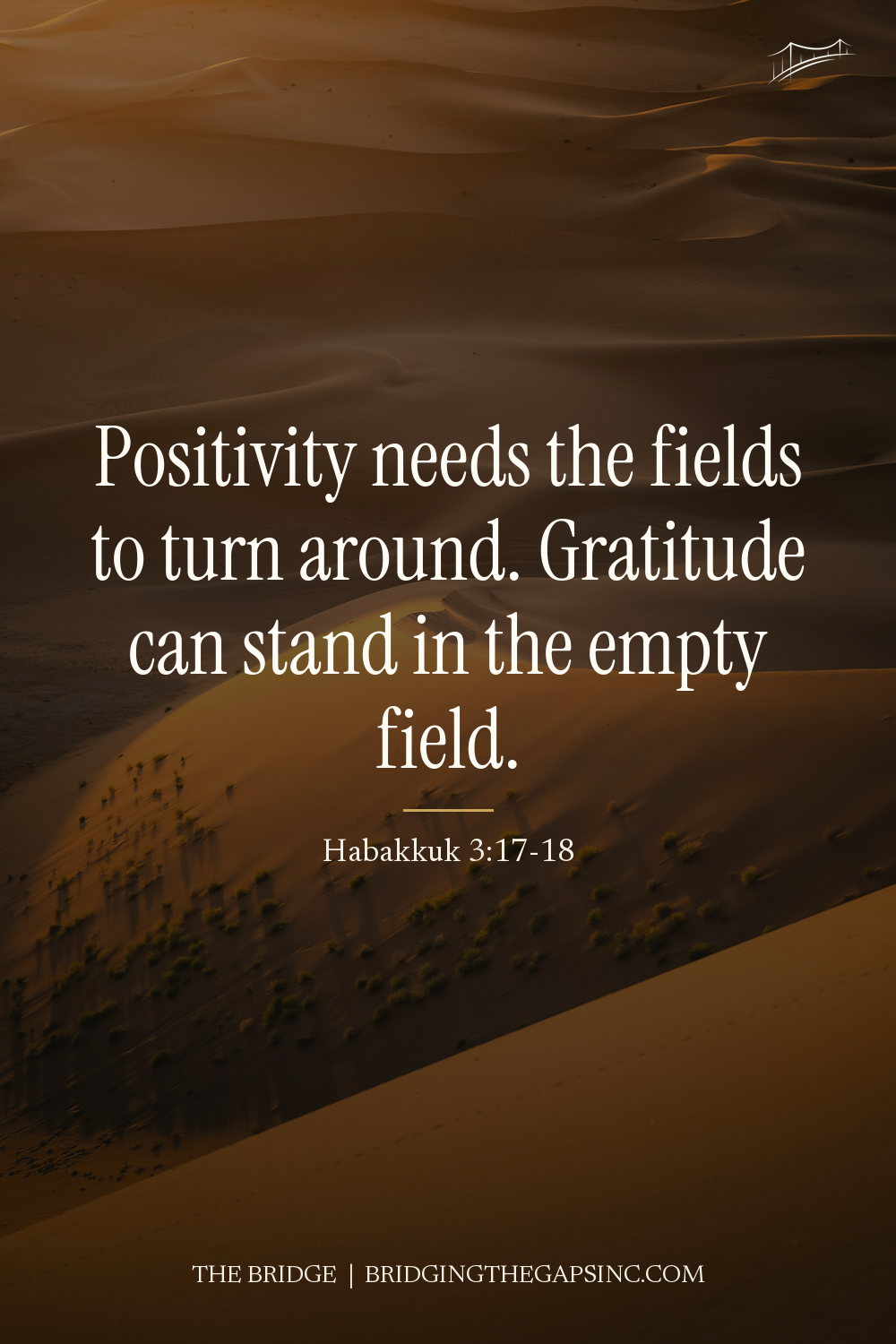
Positivity needs the fields to turn around. Gratitude can stand in the empty field.
Start by remembering
Psalm 103 doesn't tell you to feel thankful. It says "forget not all his benefits" (Psalm 103:2), and then it names them: He forgives, heals, redeems and crowns you "with lovingkindness and tender mercies." Gratitude grows when you remember on purpose. Our episode Forget Not spends a whole week in that psalm.
Thank God for who He is
Psalm 92:2 talks about showing forth "thy lovingkindness in the morning, And thy faithfulness every night." His lovingkindness and His faithfulness don't change when your day does, so there's always something to thank Him for.
Bring thanks with your requests
The next time you pray about something hard, add one honest thank-you before you finish. The hard thing is still hard, and you're still talking to a good God.
Watch for thanks that fades when life is comfortable
When things are going well, it's easy to forget where the good came from. Moses warned Israel about exactly that in Deuteronomy 8, and we looked at it in When You Are Full.
Paul said he had "learned, in whatsoever state I am, therein to be content" (Philippians 4:11). Learned means it grew over time. Yours can grow too.
A year of gratitude in the Psalms
Gratitude is one of the twelve themes in A Good God: Psalms, our 52-week devotional. Those four weeks walk through Psalm 103, Psalm 138, Psalm 92 and Psalm 65, and every week has the Psalm passage, a reflection, a prayer and space to write back to God.
Week 1 is free. Enter your email and we'll send it to you. Get the free Week 1 sampler

A Good God: Psalms is on Amazon in paperback and Kindle. You can read more on the A Good God: Psalms page, and you'll find all of our studies on the Bible Studies page. If you're new to the Psalms, What the Psalms Actually Are is a good place to start.
Father, thank You that my thankfulness doesn't have to wait for everything to look good. You're good when the fields are full, and You're good when they're empty. Help me remember what You've done, and give me a heart that turns back to thank You. In Jesus' name, Amen.
What's one thing God has done that you never want to forget? Tell us in the comments.
Frequently asked questions
Is positivity wrong for Christians?
Hope and a cheerful outlook aren't sinful. The trouble comes when positivity takes the place of gratitude, because positivity rests on circumstances and biblical thanksgiving is aimed at God.
What does the Bible say about gratitude in hard times?
1 Thessalonians 5:18 says "in everything give thanks," and Habakkuk 3:17-18 shows a prophet rejoicing in God while every harvest failed.
Is it okay to be sad and thankful at the same time?
Yes. Psalm 13 moves from honest questions to "I will sing unto Jehovah," and Philippians 4:6 pairs your requests with thanksgiving.
What is a sacrifice of thanksgiving?
Psalm 50:14 and 50:23 use that phrase. The Hebrew word todah can mean thanksgiving or a thank offering, something brought to God on purpose.
How can I become more grateful?
Start where Psalm 103 starts, by remembering. Name what God has done, and bring thanks along with your requests when you pray.
